The Quadrality Scaffold: Complementary; Civilizational & Informational Closure
This sub-directory contains formal models and theoretical frameworks exploring Domain 4 (256) of the Quadrality Scaffold. This domain represents the level of complexity where information can be encoded, stored, and transmitted reliably across generations, establishing a Deep-Time Identity.
Overview
Domain 4 is the substrate of civilization and universal encoding. It is built upon the cognitive substrate of self-aware beings (Domain 3) and enables a stable identity that persists far beyond the lifespan of an individual organism.
Domain 4 Characteristics
-
Threshold: 256 (The minimum domain capable of stable, universal encoding).
-
Substrate: Civilization / Deep-Time Identity.
-
Key Capability: Universal Encoding.
-
Primary Function: Reliable transmission of information across deep time.
Key Documents
Layer Model of Conscious Agents
-
Analyzes the transition from individual recursive self-modeling (the 64-layer) to collective civilizational modeling.
-
Describes how multiple agents integrate into a coherent meta-system or culture.
Kardashev Civilizations
-
Connects the Quadrality Scaffold to Kardashev-scale potential.
-
Discusses how achieving civilizational-scale recursion allows for the large-scale management of energy and information.
Civilizational Coherence Half-Life Model
-
Examines the structural stability of information systems within Domain 4.
-
Explores the capacity for intergenerational continuity and the factors that influence the "half-life" of cultural and technological coherence.
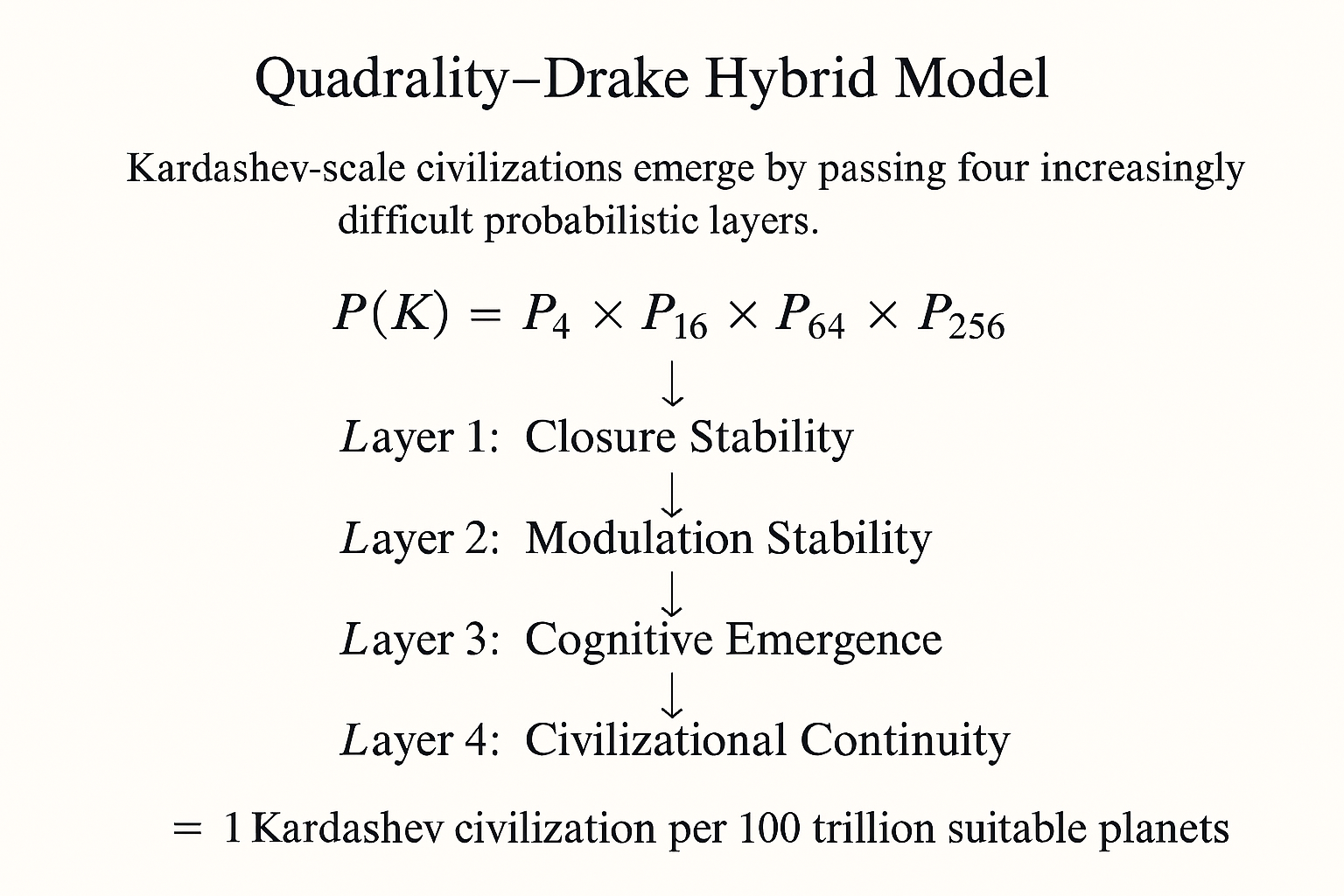
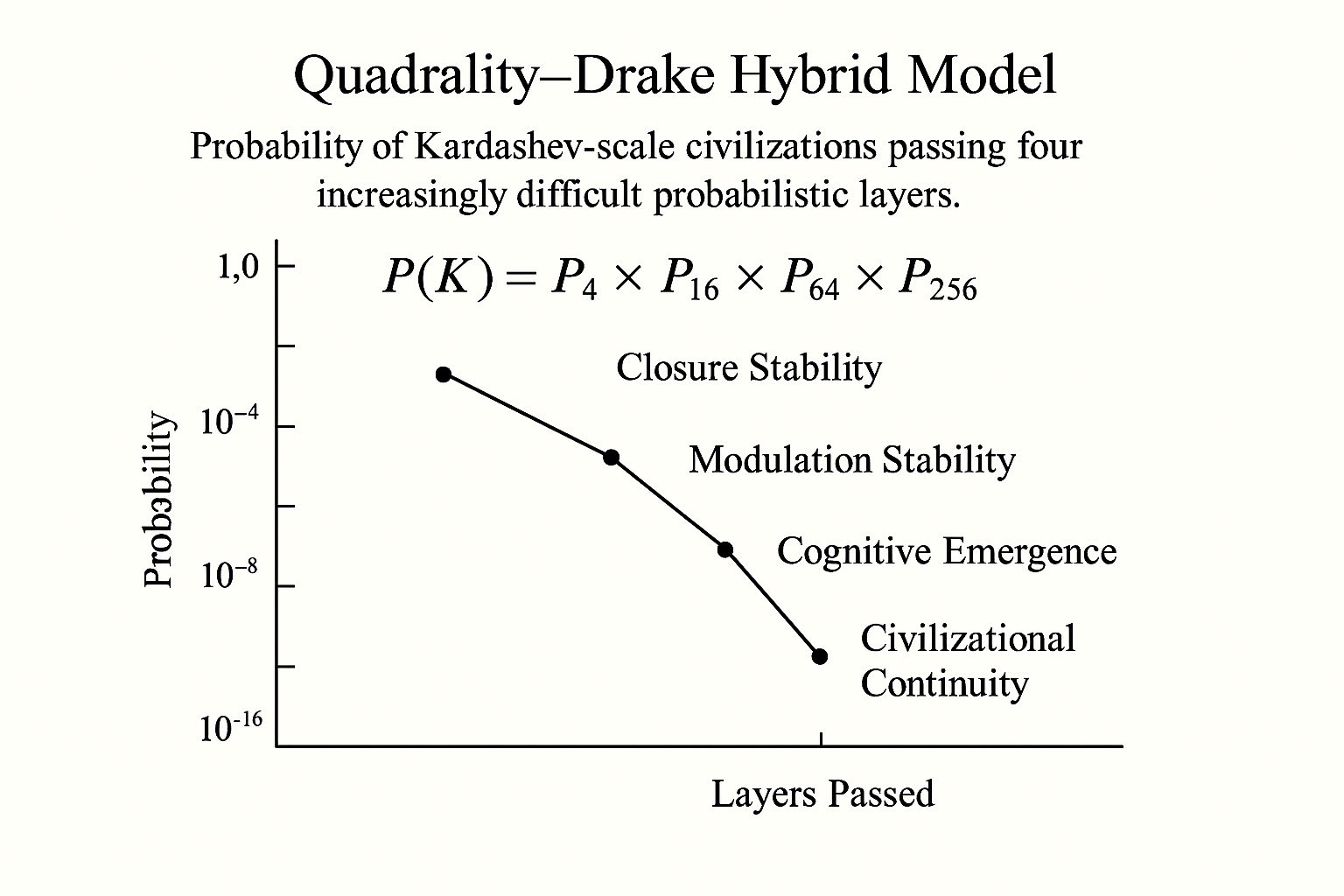
Quadrality-Drake Hybrid Model
-
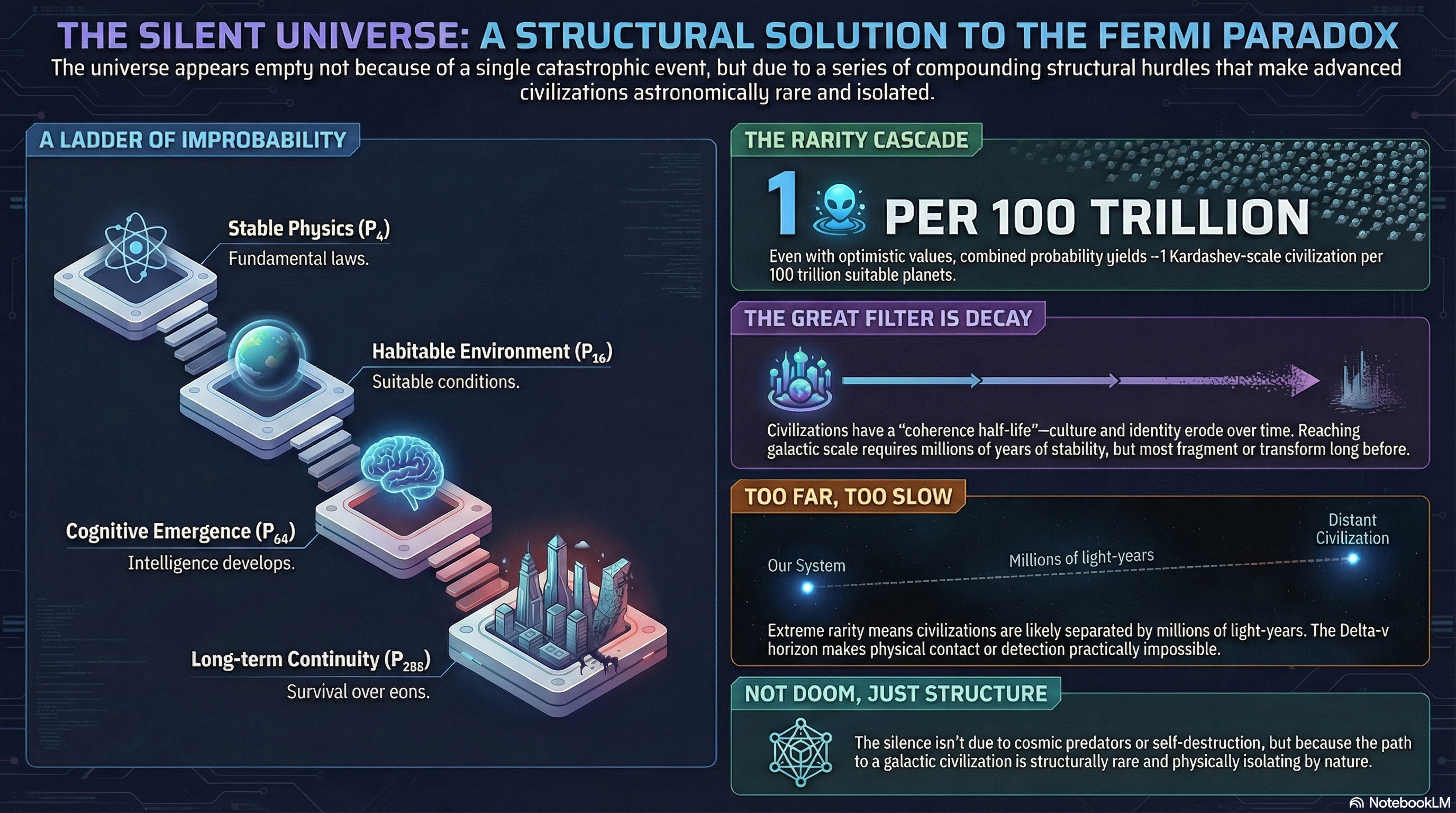
Synthesizes the scaffold with probabilistic frameworks to address the Fermi Paradox.
-
Applies the Rarity Cascade—the multiplicative rarity of successive closures—to explain why civilizations may be common in potential but rare in actuality.